SPO2 Pulse Oximeter Amplifier
Advanced Amplifier for Research Applications
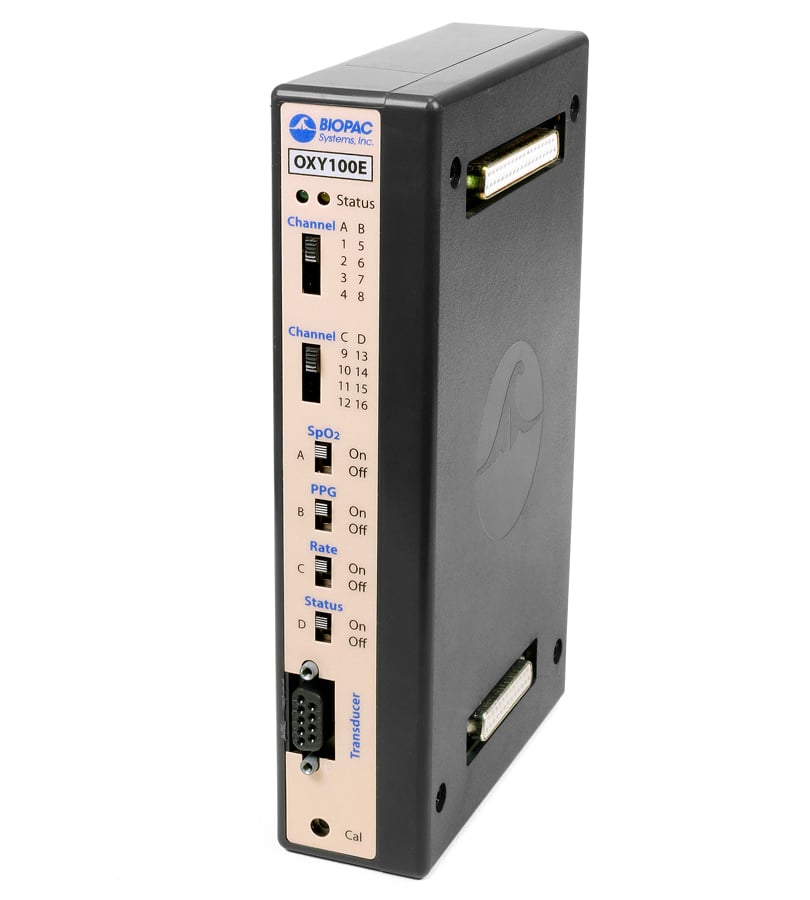
The OXY100E measures beat-by-beat, blood oxygen saturation (SpO2) level in a noninvasive fashion. The OXY100E outputs four signals simultaneously:
A: SpO2 value (Ch 1, 2, 3, or 4)
B: Pulse Plethysmogram* (Ch 5, 6, 7, or 8)
C: Heart pulse rate (Ch 9, 10, 11, or 12)
D: Module Status ( Ch 13, 14, 15, or 16)
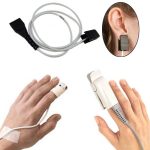
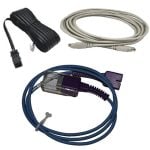
These signals are directed to switchable blocks of different MP input channels. Up to four OXY100E modules can be used with a single MP System. The OXY100E has built-in calibration for a simplified setup procedure. Each OXY100E module requires one of the TSD124 series SpO2 transducers.
* Pulse Note: The Pulse Plethysmogram output is not the raw pulse signal—the waveform is pre-conditioned using proprietary algorithms. The Pulse waveform output of the OXY100E should only be used to calculate heart rate, using the rate detector in AcqKnowledge. For a raw Pulse signal, employ the specified PPG Transducer with PPG100D Smart Amp or PPG100C Amplifier for MP160 Systems, or the SS4LA PPG Transducer for MP36R Systems.
See More...

Stay Connected