ECG: Cardiology
Complete ECG/Cardiology Research Solutions
Wired, wireless, and MR options for human and animal research
Collect ECG data from 1-, 3- or multi-lead montages; connect up to 16 input leads
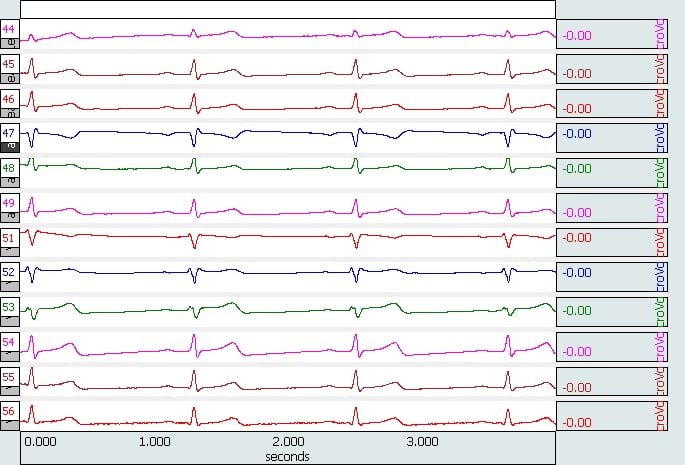
Recording options for every ECG scenario

Record ECG data from one-, three-, or multi-lead montages and implement a fully automated LEAD II analysis or automatically classify heartbeats. Recording using a variety of different ECG lead placements allows users to study the properties of the ECG wave. AcqKnowledge®software contains powerful fully automated routines for Heart Rate Variability (HRV) and Respiratory Sinus Arrhythmia (RSA) with options for frequency domain and time series analysis. It is also possible to perform statistical measures of heart rate variability in user-specified time intervals (RMSSD, SDSD, and pNN50). Record ECG and blood pressure and use the fully automated Baroreflex Sensitivity analysis .
BIOPAC has recording options for every ECG scenario, including: tethered and wireless amplifiers for the lab, specialized MRI amplifiers, recording and logging data from subjects outside the lab, and for animals using telemetry.
Try ECG tools in the free AcqKnowledge Demo
See More...Hardware Packages | ECG: Cardiology
Hardware Bundles are complete solutions for the specified application. Choose your preferred platform and bundle, then click "Request Pricing" to request an estimate, add/remove items, or complete purchase. If you have questions about specific items, click through to the product web page for details and specifications, or contact your Local Sales contact.
Wired
-
MP36R System plus ECG lead & long-term electrodes
Wired | ECG: Cardiology
MP36R with AcqKnowledge plus shielded ECG lead cable & disposable long-term electrodes
-
MP36R System plus multi-lead ECG
Wired | ECG: Cardiology
MP36R with AcqKnowledge plus multi-lead ECG cable and two disposable long term electrodes
-
MP160 System + ECG amp, leads & disposable long-term electrodes
Wired | ECG: Cardiology
MP160 plus AcqKnowledge with ECG amp, module extension cable and long-term electrodes
-
MP160 System + ECG amps, multi-lead ECG cable & disposable long-term electrodes
Wired | ECG: Cardiology
MP160 System with AcqKnowledge plus ECG amps, multi-lead ECG cable, and disposable long-term recording electrodes
MP36R System plus ECG lead & long-term electrodes
- 1 x MP36R Systems
- 1 x Lead set, shielded, BSL
- 1 x Disposable Long-term Electrodes
- 1 x Abrasive Pads 10/pk
MP36R System plus multi-lead ECG
- 1 x MP36R Systems
- 2 x Disposable Long-term Electrodes
- 1 x Multi-lead ECG Cable (MP3X)
- 1 x Abrasive Pads 10/pk
MP160 System + ECG amp, leads & disposable long-term electrodes
- 1 x MP160 Data Acquisition Systems
- 1 x ECG Electrocardiogram Amplifier
- 1 x Module Extension Cables
- 1 x Lead Wires with Clip
- 1 x Lead Wires with Clip
- 1 x Lead Wires with Clip
- 1 x Disposable Long-term Electrodes
- 1 x Abrasive Pads 10/pk
- 1 x Electrode Impedance Checker
MP160 System + ECG amps, multi-lead ECG cable & disposable long-term electrodes
- 1 x MP160 Data Acquisition Systems
- 1 x Disposable Long-term Electrodes
- 3 x ECG Electrocardiogram Amplifier
- 1 x Multi-lead ECG Cbl, C-Series
- 1 x Abrasive Pads 10/pk
- 1 x Electrode Impedance Checker
Wireless
-
BioHarness - live or logged data
Wireless | ECG: Cardiology
BioHarness "Lab on a Strap" live or logged ECG, respiration, temp, posture, and acceleration
-
MP160 System + wireless ECG amp, leads & disposable long-term electrodes
Wireless | ECG: Cardiology
MP160 System with AcqKnowledge plus BioNomadix wireless ECG amp and disposable long-term recording electrodes
-
BioNomadix Logger with long-term ECG setup
Wireless | ECG: Cardiology
BioNomadix Logger and one transmitter for wireless ECG, 30 cm leads & disposable long-term electrodes, plus Impedance Checker
BioHarness - live or logged data
- 1 x BioHarness Telemetry & Logging Systems
MP160 System + wireless ECG amp, leads & disposable long-term electrodes
- 1 x MP160 Data Acquisition Systems
- 1 x Electrode Leads - BioNomadix Wireless
- 1 x Electrode Leads - BioNomadix Wireless
- 1 x Disposable Long-term Electrodes
- 1 x BioNomadix 2Ch Wireless ECG Amplifier
- 1 x Abrasive Pads 10/pk
- 1 x Electrode Impedance Checker
BioNomadix Logger with long-term ECG setup
- 1 x BioNomadix Wireless Wearable Physiology Logger
- 1 x Electrode Leads - BioNomadix Wireless
- 1 x Electrode Leads - BioNomadix Wireless
- 1 x Disposable Long-term Electrodes
- 1 x Abrasive Pads 10/pk
- 1 x Electrode Impedance Checker
MRI
-
MP160 System + ECG MRI amp & disposable RT electrodes
MRI | ECG: Cardiology
MP160 plus AcqKnowledge with ECG MRI amp, MRI cable/filter system to biopotential amps, disposable radiotranslucent electrodes and electrode gel
MP160 System + ECG MRI amp & disposable RT electrodes
- 1 x MP160 Data Acquisition Systems
- 1 x MRI Filtered Cable Sets
- 3 x Leads - RT for MRI
- 1 x Electrode Gels
- 1 x ECG Electrocardiogram Amplifier for MRI
- 1 x Disp. Radiotranslucent Electrode, 100/pk
- 1 x Abrasive Pads 10/pk
- 1 x Electrode Impedance Checker
Animal
-
Implantable ECG
Animal | ECG: Cardiology
EPOCH implantable wireless ECG system with MP160 System for long-term monitoring of pups, mice, or rats.
-
Stellar | AcqKnowledge Intuitive Animal Scheduler License
Animal | ECG: Cardiology
Schedule, Record, and Analyze Stellar Telemetry Data with AcqKnowledge
-
MP36R System plus needle electrodes
Animal | ECG: Cardiology
MP36R with AcqKnowledge plus needle electrodes
-
MP160 System + ECG amp & needle electrodes
Animal | ECG: Cardiology
MP160 plus AcqKnowledge with ECG amp, module extension cable, and unipolar needle electrodes
Implantable ECG
- 1 x Unknown Product (Array)
- 1 x Unknown Product (Array)
- 1 x EPOCH Transmitter Activation Utility
Stellar | AcqKnowledge Intuitive Animal Scheduler License
- 1 x Unknown Product (Array)
MP36R System plus needle electrodes
- 1 x MP36R Systems
- 3 x Needle Electrodes - Animal/Tissue
- 1 x Electrode Lead Adapter, TP
MP160 System + ECG amp & needle electrodes
- 1 x MP160 Data Acquisition Systems
- 1 x Module Extension Cables
- 1 x Needle Electrodes - Animal/Tissue
- 1 x ECG Electrocardiogram Amplifier
- 1 x Electrode Impedance Checker
Details
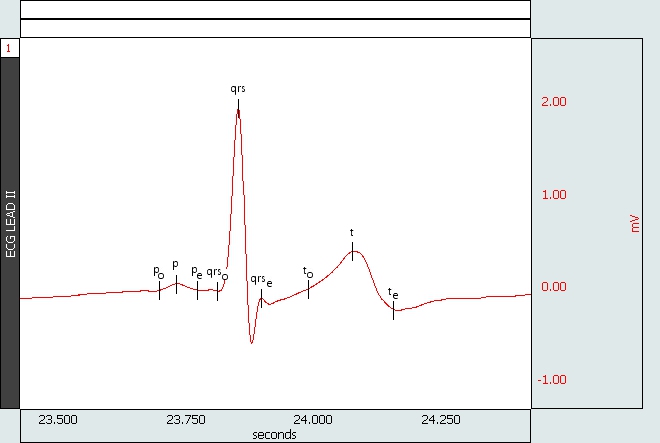
ECG Analysis Lead II
The powerful ECG averaging function evaluates changes in the ECG complex before, during, and after exercise or dosing.
Use automated data reduction tools to simplify analysis over user-defined time periods (max, min, mean, p-p, delta, time of max, time of min, and many more). Compare waveforms, find peaks, detect cycles, compute averages, and achieve complex analysis in real time or after data acquisition. Combining ECG data with other parameters lets users perform a complete physiological examination.
BIOPAC Provides Complete Solutions for Your Research!


In Lab Assessments—Use wired or wireless systems to record one or multiple leads of ECG data and monitor responses to discrete stimuli, group interactions, or other lab manipulations.
Mobile Subjects—(Wireless ECG signals) Choose from a variety of wireless systems to record ECG signals on mobile subjects in a lab environment or out in the real world. Choose to stream data live or record up to 32-channels of logged biopotential data.
Environment Simulations—Create immersive environments and monitor subjects as they interact with people and/or their environment and track changes in Heart Rate and the ECG signal. Monitor one or multiple subjects using camera systems to synchronize video data with the physiology.
Long-term Activity Studies/Data Logging—To monitor subjects in their home environments over multiple hours or days, use the Mobita System or BioHarness to record ECG before, during, and after exercise. Look at overall activity levels and responses to different daily activities.

fMRI studies—Record ECG data from subject in the fMRI using BIOPAC’s ECG Smart Amplifier. Powerful online and offline signal conditioning tools isolate the ECG signal and reduce noise.

HRV ANALYSIS
Fully automated HRV analysis – spectral, statistical and RSA
AUTOMATED ECG ANALYSIS
Fully automated ECG scoring and analysis with direct export to spreadsheet
12-Lead ECG Recordings
Cost-effective 12-lead recording with multi-lead cable, BIOPAC amplifiers
Features & Benefits
- In-lab or mobile data acquisition
- Short or long-term studies
- MRI recording solutions
Automated Analysis & Scoring Routines with AcqKnowledge
- ECG Classification
- ECG Interval Extraction
- Heart Rate Variability
Advanced Features Spotlight
AcqKnowledge provides a fully-automated ECG analysis system. The software automatically identifies and labels the points of the ECG complex. It also calculates the amplitudes and More...
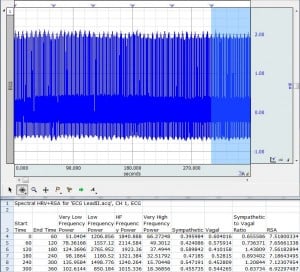
Heart Rate Variability (HRV) Analysis Software
AcqKnowledge® includes a series of automated Heart Rate Variability (HRV) analysis tools that conform to international cardiology standards. It is possible to perform the analysis More...
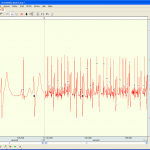
AcqKnowledge® software includes a fully automated ECG classification routine. The robust QRS detector is tuned for human ECG Lead II signals. It attempts to locate More...
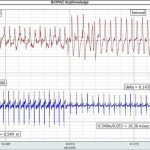
Carotid to Femoral Pulse Wave Velocity (cfPWV) measurement
Classic (gold standard) Carotid to Femoral Pulse Wave Velocity (cfPWV) measurement using BIOPAC’s MP160 Data Acquisition System with AcqKnowledge Research Software, Transducer Amplifier DA100C, Electrocardiogram More...
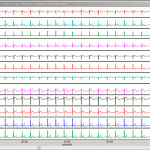
To record a continuous 12-lead ECG, use a WT100C Wilson Terminal to create a virtual reference electrode when measuring the transverse plane (i.e., precordial) ECG More...
Videos
ON DEMAND WEBINARS
ECG Recording & Analysis Techniques | Getting good ECG/EKG data, HRV, RSA, and more!
TUTORIAL VIDEOS & SCREENCASTS
BIOPAC Research Solutions | ECG
Integrating BIOPAC Research Systems | Data Acquisition & Analysis
Classify Heartbeats
Automated ECG Analysis- Lead II
Dual-Channel MRI Gating
Locate Animal ECG Complex Boundaries in AcqKnowledge
EL-CHECK Electrode Impedance Checker
BioHarness Data Logger in Action
Support
Application Notes
- 154 - High Level Transducer Connections - HLT100C
- 159 - Hand Switch and Foot Switch - TSD116 Series
- 103 - Remote Monitoring System - TEL100
- 109 - 3-, 6-, and 12-Lead ECG
- 110 - Amplifier Baseline Offset Adjustment
- 126 - Wireless Remote Monitoring - TEL100C-RF
- 136 - Battery Pack Instructions - BAT100
- 185 - iMac and G3 Compatibility Issues
- 195 - MP System Data Sampling Reference
- 206 - Continuous 12-Lead ECG
- 207 - UDP Install: MP150 + No Network Access
- 208 - UDP Install: MP150 + Domain Network Access
- 209 - UDP Install: MP150 + Network Access or Multiple Computers
- 115 - Hemodynamic Measurements
- 121 - Waveform Data Reduction
- 122 - Power Spectrum Analysis
- 129 - Heart Rate Variability
- 142 - Rate Detector Algorithm in AcqKnowledge
- 143 - Importing AcqKnowledge Data Into Excel
- 148 - Automated ECG Analysis
- 155 - AcqKnowledge File Formats for the Macintosh
- 156 - AcqKnowledge File Formats for PC With Windows
- 177 - ECG Analysis Using the Offline Averaging Mode
- 191 - Digital I/O Channels
- 204 - AcqKnowledge Peak Detector Operation
- 219 - Known Issues - AcqKnowledge
- 226 - BIOPAC Software Compatibility on Mac-Intel Core Duo Machines
- 116 - Hemodynamic Measurements - Part 2
- 172 - Multilead ECG Cable - SS29L
- 102 - Biopotential Amplifier Testing With CBLCAL
- 233 - Heart Rate Variability - Preparing Data for Analysis
- 001 - AcqKnowledge Release and OS Compatibility
- 242 - Recording ECG Data in an fMRI
- 246 - R-R Interval Processing with the BIOPAC HRV Algorithm
- 279 - ECG and EDA Recording in 7-Tesla fMRI
- 281 - ECG Timing Delay Associated with Amplifier Filter Selections
- 293 - Displaying BPM Through Seven Segment Displays
- 294 - Trans-radial Electrical Bioimpedance Velocimetry (TREV and TRUEV)
Knowledge Base
- * CLEANING GUIDELINES *
- AC mode
- AcqKnowledge accuracy
- AcqKnowledge backwards compatibility
- AcqKnowledge: Newest Features
- Amplifier baseline offset adjustment
- Amplifier conversion - 2 mm to touchproof
- Amplifier filter settings
- Audio recording synchronization
- Band-pass and band-stop filters
- Bioimpedance Methods
- Biopotential amplifier signal validation
- Buffer overflow
- Calculating file sizes
- Clinical chart grid setting for ECG
- Combining Video with AcqKnowledge
- Common mistakes/general troubleshooting
- Computing heart rate
- Connecting the TSD116C Switch Box
- Copy and paste append markers along with data
- DC mode
- Differences between the NICO100C and EBI100C
- Duplicating waveforms
- ECG Analysis
- ECG artifact in EMG Signal
- ECG R-wave detector
- Editing noisy data
- Electrode Properties - gel and adhesive
- Event Markers | Correcting Automated Placement
- Excel files exported from BIOPAC software open in Excel 'Protected View'
- Exporting Data to SPSS
- External Devices and Channel Contention
- Extracting data segments from a file
- Extracting heart rate from a noisy ECG signal
- Grounding guidelines
- Guidelines for Psychophysiological Recordings
- High pass filters
- IIR vs. FIR filters
- Interfacing third-party transducers
- Inverted Waveform
- LabView interface
- Loading Physiobank data files
- Low pass filters
- MP150 UDP protocol fixed IP address
- MRI - Triggering
- MRI Data Cleaning | PhysIO Toolbox to Remove Image Artifact
- MRI, Radiotranslucent, and Radio-opaque Compatibility
- Multiple amplifiers per subject or multiple subjects per system
- NIBP100A single pulse data analysis
- Notch filter
- Optimal ground placement
- Outputting a signal through the STM100C
- Physiological measurements - life science signals using BIOPAC
- PPG setup and calibration
- QRS Amplitiude & Respiratory Modulation
- Railing signal (flatline)
- Recording good data
- Text files - import and export
- Upgrading from PCMCIA to USB
- USB Drivers and Controller Communication
- Using other software with BIOPAC hardware
Stay Connected